TSINGHUA UNIVERSITY NEWS Updated: April, 23th
On the afternoon of April 18th, the unveiling ceremony and the first academic committee meeting of the Center for Brain-Inspired Computing Research at Tsinghua University were held in the multi-functional hall of the Information Technology Building.
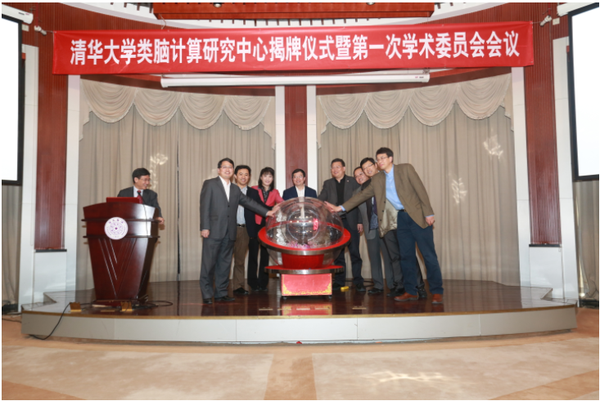
Qiu Yong, president of Tsinghua University; Gao Runsheng, deputy director-general of the Department of Science and Technology of the Ministry of Education; Shen Jianlei, director of the Division of Major Research Projects of the Department of Basic Research of the Ministry of Science and Technology and Zhang Bo, Director of Academic Committee of the Center for Brain-Inspired Computing, jointly unveiled the Center for Brain-Inspired Computing Research at Tsinghua University.
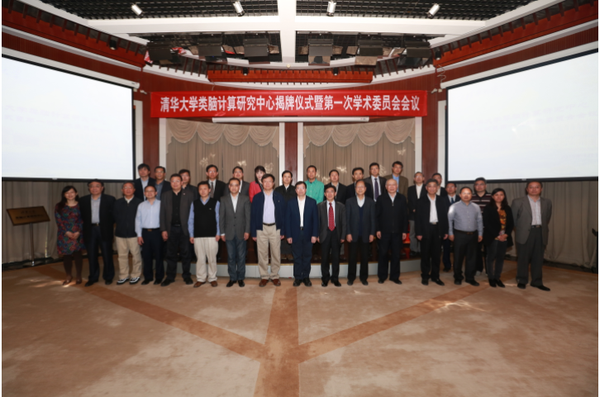
Xue Qikun, vice president of Tsinghua University, and Professor Shi Luping, director of the Center for Brain-Inspired Computing Research co-hosted the meeting. Over 40 renowned experts including members of the Academic Committee of the Center for Brain-Inspired Computing and guest reporters, along with more than 120 teachers and students from the Center for Brain-Inspired Computing Research and the wider university attended the meeting.
Qiu Yong expressed his warm congratulations on the establishment of the Center for Brain-Inspired Computing Research. He said that brain-inspired computing is an ultra-low power computing system with learning ability that approaches the information processing of the human brain and breaks the constraints of the existing frameworks. The market potential of brain-inspired computing is huge. The Brain Science and Brain-Like Intelligence Technology being prepared in China is divided into two parts: Brain Science and Brain-inspired Research. Qiu Yong hopes that the related work of Tsinghua University will contribute to the final establishment of the program. He concluded with expectations for the Center for Brain-Inspired Computing Research. First, the Center is hoped to play a positive role in the development of related disciplines in Tsinghua University and promote the deep integration of interdisciplinarity. Second, the teachers and students of the Center for Brain-Inspired Computing are hoped to endeavor together and never fail to meet the support of relevant ministries and commissions and experts. The greater contributions are expected to be made to the development of brain-inspired research in China while their making more achievements.
He also pointed out that China will embark upon a series of major projects for 2030, leading the national effort to promote economic transformation. The establishment of the Center for Brain-Inspired Computing Research at Tsinghua University will make a great contribution to the implementation of major projects in China. Gao Runsheng emphasized that human brain science and brain-inspired research will be the highlights of competitive scientific research across various countries in the future. Whoever seizes the highlights will take the initiative in the future development.
Shen Jianlei also conveyed in his speech that the Ministry of Science and Technology pays great attention to brain-inspired research.
Academic Zhang Bo thoroughly analyzed the current challenges and opportunities in the fields of information and brain science research using his decades of experience in Information Science research, and put forward his suggestions.
Following the speeches, Qiu Yong, Gao Runsheng, Shen Jianlei and Zhang Bo jointly unveiled the Center for Brain-Inspired Computing Research at Tsinghua University. The president and deans of the seven departments participating in the construction of the center jointly expressed congratulations around the crystal ball of “Work Together to Create Brilliance”. They are: Academician You Zheng, president assistant and dean of the Department of Precision Instruments; Huang Yidong, dean of the Department of Electronic Engineering; Qian He, secretary of the Party Committee of the Institute of Microelectronics; Hong Bo, secretary of the Party Committee of the School of Medicine; Zhu Wenwu, deputy director of the Department of Computer Science and Technology; Zhuang Daming, executive deputy dean of the School of Materials Science and Technology and Hu Jianming, deputy secretary of the Party Committee of the Department of Automation.
Next, Shi Luping reported the development goals of the Center and its overall work since its establishment last year, and elaborated upon the relevant research route, content and program. Professors Yang Huazhong, Qian He, Zhang Youhui, Chen Feng, Song Sen and Zhang Xiaozhong of the Center made a comprehensive special report, presenting six aspects respectively. They described the outstanding work and profound understanding of the brain-inspired computing team at Tsinghua University in relation to the study of brain-inspired computing, including the design, process and integration of brain-inspired chip systems, simulation software, modeling and coding, brain computing, devices and material, etc.
Xue Qikun pointed out during his hosting that brain-inspired computing is facing enormous challenges and contains unique opportunities. It is hoped that the teachers and students of the Center for Brain-Inspired Computing Research will stick to their high aspirations, strive to tackle key problems, seize opportunities and face challenges, and make contributions to China’s education as well as the development of information technology in the future, and indeed the progression of humankind.
After the report, the Academic Committee of the Center for Brain-Inspired Computing Research held its first academic meeting in the Huaye Building.
The study of brain-inspired computing is not only a stimulating aspect of scientific research, but also a bold attempt at the comprehensive reform of colleges and the development of national innovation.
(Contributor: Office of Scientific R&D)
Editor: Xiang Hua, Lei Lei(http://news.tsinghua.edu.cn)