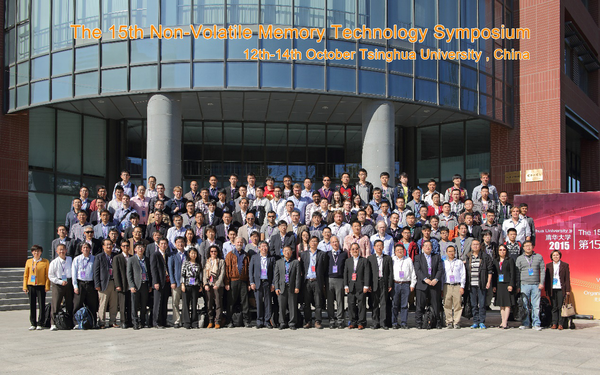
The 15th Non-Volatile Memory Technology Symposium (NVMTS 2015), sponsored by the International Institute of Electrical and Electronic Engineers (IEEE), was held at Tsinghua University in Beijing, from October 12th to 14th.
The International Symposium on Non-Volatile Memories is a high-level international academic conference sponsored by IEEE, aiming at providing a good communication environment for scientific research and industrycolleagues in the field of non-volatile memories. More than 200 experts, scholars and graduate students from the United States, France, Germany, Singapore, Japan, South Korea, China and Taiwan participated in the conference.
The opening ceremony of the conference was presided over by Professor Shi Luping, Co-Chairman of the Organising Committee of the conference and professor at Tsinghua University. Professor Xue Qikun—vice president of Tsinghua University and academy member of the Chinese Academy of Sciences—delivered a speech to welcome and thank the experts and scholars at home and abroad who actively participated in the meeting. President Xue said that in the past 50 years, great progress has taken place in the field of non-volatile memory, which has promoted the development of the semiconductor and information technology industries. This is the first year that the topic of neuromorphic computing and devices has been included at the conference. Tsinghua University, as a centuries-old famous university in China, has advanced non-volatile memory processing platform and technology, and established the Brain Computing Research Centre last year, aiming at seeking a new computing system paradigm based on the brain’s working mechanisms. It is hoped that this conference will provide an opportunity for experts and scholars from all over the world to discuss and exchange various new non-volatile memory technologies.
Dr. R. Stanley Williams from HP Labs, Dr. Yukihito Oowaki from Toshiba, Dr. G.H. Koh from Samsung, Dr. Kang L. Wang from the University of California, Los Angeles, Dr. Hongsik Jeong of Yonsei University and Chris Eliasmith of the University of Waterloo—a total of six top scholars and experts in the field of non-volatile memory—made excellent keynote contributions.
Delegates came from the University of California, Los Angeles; the University of California, Santa Barbara; the University of Pennsylvania; the University of Minnesota; Carnegie Mellon University; Aachen University of Technology, Tokyo University; the Japan Institute of Nanoelectronics; Pohang University of Science and Technology; the National University of Singapore; the Singapore University of Science and Technology and Design; the Shanghai Institute of Microsystems and the Chinese Academy of Sciences. Thirty-two scientists from the Institute of Microelectronics of the Chinese Academy of Sciences; IBM; Qualcomm; Meguiar; Panasonic; Hitachi and Toshiba made special reports. Fifty-two scientists and graduate students from around the world made presentations.
The conference was divided into ten themes, focusing on magnetic memory, spin-transfer torque memory, resistive random access memory, phase change memory, neural morphological computing and devices, memory system integration and other fields. It is worth noting that this conference has added two topics—neuromorphic devices and neuromorphic systems related to brain-inspired computing—which are the current global research hotspots. Brain-inspired computing is a new field, which aims to break the von Neumann architecture constraints and become suitable for real-time processing of unstructured information, with the autonomous learning ability of an ultra-low power computing system. It will lead an intelligent revolution and will greatly expand the scope of human intellectual activities in various fields. During the three-day conference, the atmosphere was warm and the academic contributions were extremely strong.
Professor Shi Luping of Tsinghua University, co-chairman of the organising committee of the conference, presided over the award for the best posted paper, and finally Kang L. Wang of UCLA, co-chairman of the organising committee of NVMTS2015, delivered a closing speech on behalf of the conference.
This conference discusses new nonvolatile storage technologies and advances in existing nonvolatile storage technologies, and industry experts and academics exchanged innovations and advances. The conference was unanimously praised by the experts, scholars and delegates attending the conference.
The field of non-volatile memory is a cutting-edge topic in global science and technology, and China has also made important contributions to this area. Hosting this conference provided a valuable opportunity for Chinese scientists to understand international development trends and global trends in this field, and at the same time enabled colleagues across the world to understand China and Tsinghua University. It improved the academic status and influence of our country in the field of non-volatile memory. Tsinghua University has been committed to the development and application of non-volatile memory, and hosting this conference provided a significant opportunity for Tsinghua University to strengthen exchanges and cooperation in this field.